7 Brutal Reasons Why Getting a Job in 2026 Is Shockingly Hard
🕐 9 min read
June 2026
🔥 Trending
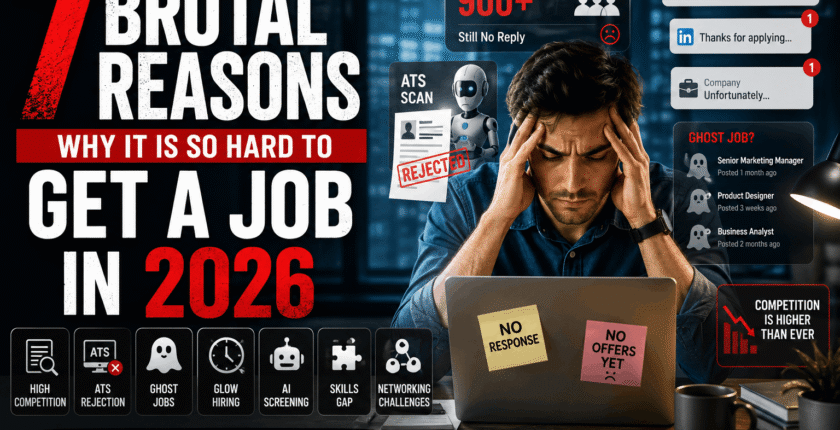
7 Brutal Reasons why it is hard to get a job in 2026
By Faraz Ahmad | Founder, Vestrz | Career Guidance

Okay so let me tell you something that happened to someone I know personally. This guy spent four months applying non stop. Morning alarms spreadsheets and cover letters rewritten a hundred times. Out of 130 plus applications he got maybe 11 responses back. Three interviews happened. Zero offers came. And what really got to him was not the rejection itself it was that he had no idea what he was doing wrong. Resume looked fine. Experience was real. Still nothing.
I kept hearing similar stories throughout this year from people in my network people commenting on posts people reaching out directly. And every time someone asks me why job hunting feels this broken right now, the honest answer has nothing to do with what career coaches usually say. It goes deeper than “update your LinkedIn” or “follow up after interviews.”
So here is what is actually happening out there right now explained as plainly as I can manage.
By the Numbers in 2026
1. The Sheer Volume of Applications Has Made the System Fall Apart
Nobody talks about this part openly but it is the first thing hiring managers complain about when you get them off the record. A single job posting on LinkedIn today can pull in anywhere from 800 to over a thousand applications before the first 48 hours are even done. These are not spam accounts or bots either. These are actual qualified people who need work.
One recruiter I spoke with earlier this year said she had to manually close a posting after just three days because her team physically could not process what came in. They ended up reviewing maybe 60 resumes out of over 900 received. Think about that number for a second. You could have a flawless resume and genuinely be perfect for the role but if you applied on day two there is a real chance nobody ever opened your file.
And the brutal irony is that because people know competition is insane they apply to even more jobs to compensate which just makes the pile taller for everyone. Nobody wins in that loop.
Sending out 50 applications a week can feel productive but if the resume itself is not built right none of that effort actually reaches a person. Focused and targeted always beats scattered and high volume when it comes to job searching.
2. A Robot Reads Your Resume First and Most Resumes Fail That Test
Here is the part that frustrates me the most because so few people applying for jobs right now actually understand it. Almost every company above a certain size uses software called an Applicant Tracking System, or ATS, to screen incoming resumes before any human touches them. Workday, Greenhouse, Lever, iCIMS, these names come up constantly.
What these systems do is scan your resume for specific keywords check whether the formatting is readable and score you based on how well you match the job description on paper. If your score is low the software buries your application and a recruiter never sees it. Game over before it even started.
The mistake most people make is caring too much about how the resume looks visually. They open Canva pick something with two columns and little icons next to each skill spend three hours making it beautiful and export a gorgeous PDF. The ATS then reads that file and gets completely confused by the layout. Skills end up in the wrong section work history gets scrambled contact info disappears. The whole thing looks like nonsense to the software. Tools like Jobscan or Resume Worded actually let you test your resume against a real job description before submitting. Worth doing before every application honestly.
Fancy Canva resume with multiple columns text boxes and decorative icons. Looks incredible as a PDF. Gets completely mangled by ATS software. A plain single column format with real text is what actually passes through these systems properly.
3. A Huge Chunk of Job Postings Are Not Real and Nobody Tells You That
Ghost jobs. I genuinely did not believe this was as widespread as it is until I started digging into it. A ghost job is a posting that sits live on Indeed or LinkedIn or a company careers page even though the company is not actively looking to fill that position right now.
Why does this happen? A few reasons. Sometimes internal HR processes make it easier to just leave a posting up than to go through the steps of officially closing it. Some companies post roles on purpose to collect resumes for future hiring even if they have no immediate opening. Others are in the middle of budget decisions and not sure if the hire will actually get approved. And in some cases particularly in larger companies the position is technically open but there is already an internal candidate being lined up and the external posting is mostly formality.
Research from the past couple of years put estimates between 20 and 40 percent of active job listings potentially falling into this category at any given moment. That is a significant slice of your effort going nowhere.
Pull up the posting date. Any role sitting open for 60 days or more on LinkedIn with a couple thousand applicants already and no update is worth being suspicious about. Does not always mean it is fake but it is a signal worth noticing before you spend hours on a tailored application.
4. Even When Companies Are Hiring the Process Takes Forever Now
Remember when getting a job offer used to take two or three weeks start to finish? That timeline has pretty much disappeared for most roles at mid to large companies. Right now four to six rounds of interviews spread across two to three months is increasingly normal and some people are going through longer processes than that.
Part of this comes from how cautious companies have become after rounds of layoffs and tighter budgets. Nobody wants to make a hiring mistake they will have to undo in six months. So more people get pulled into the decision more approval stages get added and the whole thing drags. Add an understaffed HR team to the mix and you have a process that moves at whatever speed it wants with no urgency whatsoever from their side.
From where you are sitting it feels awful. You finish a first round genuinely feel like it went well then hear nothing for three weeks. You follow up politely. Another interview happens. More silence. A month goes by. Then a rejection arrives with zero explanation. That cycle messes with people mentally far more than the rejection itself does.
Send a thank you email within 24 hours of any interview just two or three genuine sentences nothing long. If two weeks pass without a word one follow up message is completely appropriate. More than one in a short span tends to backfire though.
5. AI Is Screening People Out and the System Is Far From Fair
This one is relatively new but it is becoming a bigger factor fast. A growing number of companies now use AI powered tools not just to sort resumes but to conduct early stage video interviews where algorithms analyze things like your word choice speaking pace and facial expressions during the recording. HireVue is probably the most well known platform in this space but it is far from the only one.
The documented problems with these tools are real. They carry biases that disadvantage certain accents certain ways of speaking certain cultural communication styles. A highly qualified candidate can get a low score and never hear back for reasons that have genuinely nothing to do with whether they could do the job well.
Meanwhile on the applicant side AI tools that auto submit applications to hundreds of jobs at once have become more common too. So recruiters are drowning in volume while also relying on imperfect AI filters to manage it. The result is a system that regularly misses good people on both ends of the process.

Drop the corporate buzzwords completely. Nothing kills your score faster than “dynamic team player with a passion for excellence.” Write what you actually did in plain language with specific numbers attached wherever possible. AI tools reward specificity over filler every single time.
6. Everyone Talks About a Skills Gap But Nobody Explains What It Actually Means
The phrase “skills gap” has been thrown around so much that it has lost any real meaning for most people. When someone hears it they immediately think they need to enroll in another course or get another certification. Usually that is not the problem at all.
What employers actually want in 2026 is proof. Not theoretical knowledge not a credential from an online course not a resume line that says “proficient in.” They want evidence that you have done the specific thing they need done. Companies have quietly stopped treating new hires like people they will invest in and train over time. The expectation now is that you walk in ready to contribute from day one, ideally week one.
For career changers and recent graduates this reality is particularly harsh. You completed the program. Maybe you even passed the certification exam. But if you have nothing to show, no project, no client work, no portfolio, no case study then from a hiring manager’s perspective you are exactly as qualified as someone who claims the same skills with no evidence either. That is the gap nobody names clearly.
Pick one project build it properly and put it somewhere visible. GitHub a basic portfolio page even a well written LinkedIn post walking through what you built and what you learned from it. That single piece of real evidence does more for your applications than three new certificates would.
7. Networking Gets Mentioned Everywhere But the Advice Is Usually Wrong
Ask anyone who has been through a serious job search recently and they will tell you that networking is where things actually move. Not job boards, not easy apply buttons, networking. But the version of networking most people try is the version that does not work at all.
You know the message. “Hi I came across your profile and I am currently exploring opportunities in this space. Would love to connect and maybe learn from your experience.” Sent to a stranger with no prior interaction. No shared context. Just someone sliding into a professional inbox asking for something. Those messages get ignored at a very high rate, and honestly the people ignoring them are not being rude, they just receive fifteen of them a week.
What works is slower and requires more patience but it actually produces results. Find people on LinkedIn whose roles you genuinely want to have someday. Follow them. Read what they post. Leave a comment that adds something to the conversation rather than just reacting. Do that for a few weeks. Then when you send a message you are not a stranger anymore you are someone they have seen around. Keep the message short and ask one specific question about their path. Not “can you help me get a job” just genuine curiosity about their experience. Most people respond to that.
For finding the right people to connect with LinkedIn Jobs combined with the People search filter is the most practical starting point I know of.
🎯 What To Actually Do Differently Right Now
- Cut the target list down hard. Fifteen to twenty companies you genuinely care about not eighty random ones. Spend real time researching each. That research shows up in every interaction you have with them.
- Rebuild the resume for ATS first. Single column no design elements keywords pulled directly from the job description you are applying to. Run it through Jobscan before hitting submit.
- Submit early not eventually. Applications sent within the first day or two of a posting going live get reviewed at a significantly higher rate than ones sent five days later.
- Put something clickable out there. A GitHub repo a basic personal site a detailed LinkedIn post explaining a project you worked on. Recruiters want to see something not just read claims on a page.
- Ask your existing contacts first.
- A referral from someone already inside a company can move your resume from the pile directly into a recruiter’s hands. Even loose connections matter here more than people think.
- Track the whole search in one place. Use a spreadsheet or something free like Notion or Huntr. Where you applied what happened and when to follow up. Job searching without any system behind it is genuinely exhausting and easy to lose track of.
So Who Is Actually Landing Jobs Right Now?
People are getting hired. I want to be clear about that because it is easy to start feeling like nobody is. But the candidates who are landing offers in this market tend to share a few specific habits that separate them from people who are applying just as hard and hearing nothing back.
They apply to fewer companies but know each one much better. They have at least one thing a recruiter can actually click on and look at a project a portfolio a piece of writing something that supports what their resume says. They respond promptly follow up once when appropriate and do not let the silence between stages derail their focus. And perhaps most importantly they treat the search like actual work showing up every day with some kind of activity rather than going through cycles of intense effort followed by two weeks of waiting and refreshing.
If every job you apply to requires skills you genuinely have not built yet more applications is not the answer. Thirty to sixty days of deliberate skill building followed by a more targeted search will outperform six months of rejections every time. That timeline feels painful to accept when you need a job now but it is the faster route mathematically.

Here Is What I Actually Think About All of This
The job market in 2026 is harder than it was a few years back and anyone who tells you otherwise has not been through a recent search. The competition is real the automation is real the slow timelines are real and the frustration people feel is completely valid.
But the candidates still getting hired are not luckier than you. They just learned how the current version of the system works and adjusted accordingly. The people stuck in long searches are often still running a 2019 job search strategy in a 2026 job market.
You are not the problem. The process is genuinely messy and often unfair. The move is to understand the mess clearly enough to navigate it better than most people do. That is entirely learnable.