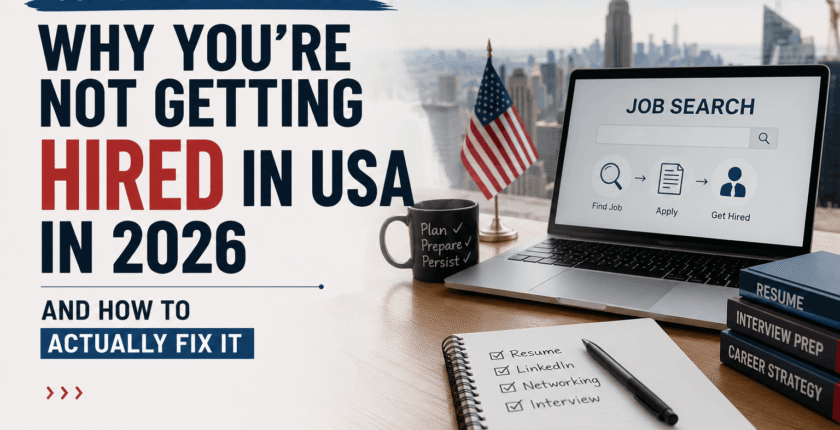
Why You’re Not Getting Hired in the USA in 2026 And How to Fix It
CAREER GUIDE · USA JOBS
Why You’re Not Getting Hired in USA in the 2026 And How to Actually Fix It: USA Job Search 2026
Three months. 160 applications. Two callbacks. This is the reality for a lot of people right now and most of them are making the same fixable mistakes.
I want to start with something real. A guy I know solid background no employment gaps applied to over 160 jobs across the USA between January and March this year. Two callbacks. That is it. He was not lazy. He was not unqualified. He was just doing things the way people used to do them and the game has quietly changed.
The job market in 2026 is not impossible. But it has shifted in ways that catch a lot of people off guard especially if your last real job search was three or four years ago. What worked then genuinely does not work the same way now. And nobody really tells you that directly.
So let me do that.

The first thing that kills most applications before anyone even reads them
Most people still do not fully accept this even though it has been true for years. When you apply to any company with more than a few dozen employees your resume almost certainly goes through an Applicant Tracking System before a human being looks at it. This is a piece of software that scans resumes for keywords, structure and relevance. It ranks you If your score is too low, you simply get filtered out and nobody ever sees your name.
The thing is, people keep designing resumes to impress human readers. Two columns, icons, graphs showing skill levels, fancy fonts. All of that can break an ATS. The software tries to read left to right top to bottom and when it hits a two column layout it often scrambles the content entirely. Your work experience ends up jumbled with your education. Your name might not even parse right.
The other issue is exact language. If a job posting says client relationship management and your resume says customer service, the ATS might score you poorly even if you have done essentially the same job. These systems match phrases, not concepts. They are not smart. They are literal.
Fixing this is genuinely unglamorous. Single column layout. Standard section headings. No graphics or tables. Mirror the actual words from the job description. That is the whole fix. Boring but it works. Tools like Jobscan let you paste in a job posting and your resume and see your keyword match score. Aim for above 70 percent on roles you really want.
Sending 80 applications is not a strategy. It just feels like one.
There is something psychologically comforting about sending a lot of applications. It feels productive. You are doing something. The problem is that volume without targeting is just noise and in 2026 recruiters can often tell the difference between a tailored application and a copy paste one within about 30 seconds.
When your resume summary says something like “results-driven professional passionate about excellence” which is a sentence that could apply to literally any human being on earth it signals immediately that you did not think carefully about this specific role. When your cover letter does not mention anything specific about the company, same signal.
I talked to a recruiter at a mid size company in Austin who told me she can usually tell in the first paragraph of a cover letter whether the person actually read the job description. Most of them had not.
The better approach: pick 15 to 20 jobs at a time that actually fit your background. Spend real time on each one. Adjust your resume summary, swap in two or three bullet points that directly match what they are asking for, write a cover letter that references something specific about the company. That level of effort on fewer applications consistently beats blasting out 100 generic ones.

Your LinkedIn profile is either working for you or against you right now
A lot of people treat LinkedIn like a backup resume they update every couple of years. In 2026 it is closer to a live job application that recruiters actively search through, often looking for candidates before or instead of posting a job publicly.
Recruiters use filters: job title, location, years of experience, keywords in your profile. If your profile is thin, outdated, or set to private, you are invisible to those searches. You might be the right person for a role that never gets posted, and someone else gets found because their profile was current and yours was not.
The things that actually matter: a real photo, a headline that says what you do and what you are looking for, a summary that sounds like a person wrote it, and experience bullets with actual results not just duties. Also turn on Open to Work either publicly or in the recruiter only setting. A lot of people skip this and then wonder why nobody is reaching out.
One small thing that sounds minor but genuinely matters if your LinkedIn URL still has a random string of numbers in it, customize it to your name in settings. It looks more professional when it is on your resume.
What the actual hiring timeline looks like this year
People spiral when they do not hear back for two weeks and assume they were rejected. Understanding what normal actually looks like in 2026 saves a lot of unnecessary anxiety.
For most mid-level roles, the realistic timeline from application to offer is three to six weeks minimum. For senior roles it often stretches longer. You apply, silence for a week or more, then maybe an automated confirmation. Then a recruiter screen. Then a hiring manager call. Then a panel interview. Then a skills assessment. Then internal approvals. Then an offer. Each stage has its own delay.
Ghost interviewing where a company schedules something and then goes silent is genuinely common now. It is bad practice but it happens. If you have an interview on the calendar and have not gotten a confirmation or logistics email 48 hours before, send a short check-in. That is not being annoying. That is being professional.
After an interview, if you have not heard anything in five to seven business days, send one follow-up email. One. Short and polite. A lot of candidates never do this and lose ground to someone who simply stayed in contact.
The mistakes that are quietly getting people rejected some of these sting
Writing a resume summary that could describe any person alive. Starting with “hardworking team player seeking a challenging opportunity to grow” is essentially saying nothing. Replace it with something specific: what you do, how long you have been doing it, what kind of role you are targeting.
Listing job duties instead of accomplishments. “Managed social media accounts” means nothing to a recruiter. “Grew Instagram from 3,800 to 19,000 followers in seven months” means a lot. Even if you do not have dramatic numbers, describe scope and impact. How many people did you work with? What improved because of your work? What would have gone worse without you?
A bad or embarrassing email address. This still happens in 2026 more than you would think. partylover94@yahoo.com on a job application is immediately unprofessional. Make a clean Gmail with your first and last name. Takes five minutes.
Applying to jobs that are clearly too far above your experience level. Occasional stretch applications are fine. But if you are consistently applying to roles that ask for 8 years of experience when you have 2, that behavior on platforms like LinkedIn can affect how their algorithm treats you in other searches.
The networking part that most people either skip or do badly
Research on USA hiring consistently shows that somewhere around 70 to 80 percent of jobs get filled through referrals or networking rather than through public applications. A lot of positions are filled before they are ever posted. They go to someone whose name came up in a conversation, someone who reached out at the right time, someone who was already in the pipeline.
Networking in 2026 does not require events or cold phone calls. It looks like commenting thoughtfully on LinkedIn posts from people in your field. It looks like messaging someone genuinely not to ask for a job but to ask one specific question about their experience. It looks like keeping loose contact with former colleagues even just occasionally engaging with what they share.
The message that gets responses looks something like this: “Hi, I came across your post about [specific thing] and found it genuinely useful. I am exploring roles in this space and would love to hear briefly how you got into your current role if you ever have 10 minutes — no pressure at all.”
Specific. Short. Human. Not asking for a job or a referral. Just starting a real conversation. That version works. A four paragraph message about your entire career history asking if they know of any openings does not.
Interview prep what actually separates people who get offers
Most candidates prepare by rehearsing answers to common questions. That is fine but it is the minimum. What actually sets people apart in 2026 is the depth of company research and the quality of questions they ask at the end of the interview.
Interviewers consistently say that candidates who clearly know the company, its recent challenges, its products, its competitors, stand out within the first few minutes. Spending 45 minutes reading the company blog, recent press coverage, and a few Glassdoor reviews puts you ahead of most people interviewing for the same role without much extra effort.
For behavioral questions the STAR format (Situation, Task, Action, Result) is still the standard. The mistake most people make is spending too long setting up the situation and not enough time on what they specifically did and what the outcome was. Interviewers want to understand your thinking and your impact, not a long backstory.
Skills assessments are now standard for most roles, not just technical ones. Writing tests for marketing. Case studies for operations. Scenario exercises for customer-facing roles. Do not rush these. Take your time and treat them as seriously as the interview itself.
The salary conversation stop leaving money on the table
When a recruiter asks about salary expectations early in the process, a lot of candidates either throw out a low number to seem “easy to work with” or say they are flexible and let the company set the floor. Both approaches usually hurt you.
Do the research before the call happens. Glassdoor and Levels.fyi (especially for tech) and LinkedIn Salary all give real ranges for specific roles in specific cities. Know your number.
When asked, give a range where your target sits in the lower half, not at the bottom. Something like: “Based on my research and the scope of this role, I am targeting somewhere in the range of X to Y, though I am open to discussing the full package.” That tells them you are informed without being rigid, and it protects you from anchoring too low.

Is it worth pushing through all of this?
Yes. Genuinely yes, without any motivational poster energy about it.
The USA job market in 2026 is harder and slower than it was two or three years ago. The tech layoffs added a lot of experienced candidates to an already competitive pool. Companies are taking longer to make decisions. Remote work opened up applications nationally so you are competing with more people. All of that is real.
But the people landing jobs are not always the most qualified candidates applying. They are usually the ones who are being strategic, patient, and consistent. They treat the job search as its own project with a plan. They track what they have sent and what response rate they are getting. When something is not working they adjust it instead of just doing more of the same thing louder.
If you are several months in with nothing to show for it, that is frustrating and valid. But it is almost always fixable. The resume, the targeting, the LinkedIn presence, the outreach one of those is the bottleneck. Find it. Fix it. The job is out there.