
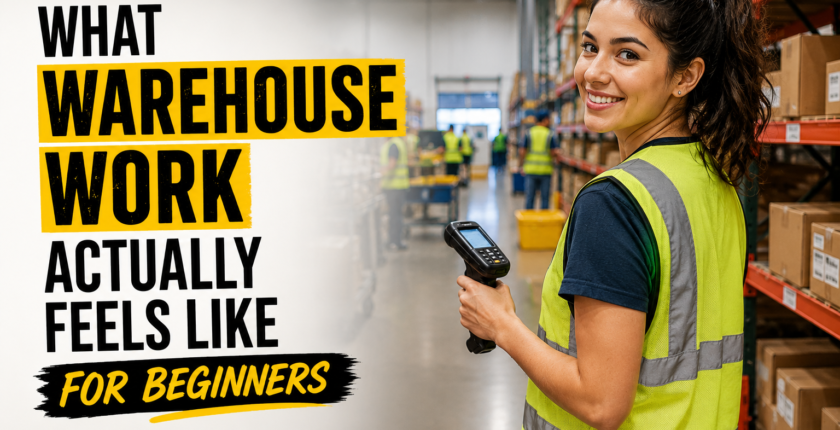
What Warehouse Work Actually Feels Like for Beginners
Vestrz Career Insights
What Warehouse Work for beginners Actually Feels Like for Beginners
I’ve talked to a lot of people who walked into warehouse jobs thinking it’d be manageable. Not easy sure but manageable. Load some stuff, scan some items, go home. Most of them were surprised by how different the real thing felt compared to what they imagined. Not in a dramatic way. Just in that quiet grinding way where your body aches and your brain feels foggy by day four.
So this piece is just me laying it out straight. No fluff about career growth or buzzwords about opportunity. Just what it’s actually like when you start what trips people up and whether this kind of work is actually a good move for you right now.

Nobody Tells You About the Feet
Seriously. Everyone focuses on the lifting the heavy boxes the physical side. And yeah that stuff is real. But the thing that wrecks beginners in week one isn’t heavy lifting. It’s the standing. The walking. The constant movement on concrete floors for eight or ten hours with barely a break.
Warehouse floors are hard. Not just hard like tile hard like industrial concrete that does not give at all under your weight. Your legs absorb every step. Some people walk 10 to 15 miles per shift depending on how big the facility is. You don’t notice it in the first three hours. You notice it around hour six when your lower back starts tightening up and your heels feel like they’re bruised.
The people who handle week one best are almost always the ones who showed up in decent footwear. Not running shoes. Not old beat up sneakers. Actual work boots with arch support and some cushioning. It sounds like a small thing but it makes a real difference. Spend $80 to $100 before your first shift. Your knees will thank you for months.
The Scan Rate Thing That Surprises Everyone
This is probably the biggest shock for people starting out especially at big operations like Amazon fulfillment centers or large distribution hubs.
Your productivity is tracked. Not loosely not occasionally. Constantly. The scanner in your hand knows how fast you’re moving how many items you’ve picked how long you spent at each location. There’s a number you’re supposed to hit per hour. Miss it too many times and you start getting warnings. Keep missing it and you’re gone.
“I was hitting 82% of my rate and thought I was doing alright. Turns out they needed 100% within the first two weeks or you get flagged. My trainer never told me that. I found out from a coworker.”
New hires get a grace period at most places. But it’s shorter than you’d expect. Some facilities give you a full training period of a week or two. Others expect you to be close to pace by day three. The honest move is to ask your supervisor directly on day one: “What’s the rate expectation and when do I need to hit it by?” Don’t wait for someone to bring it up. They sometimes won’t.

What You’re Actually Doing All Day
Warehouse jobs aren’t one thing. Even within the same building different roles feel very different. Most entry level workers rotate through a few of these or get assigned to one:
Picking
You carry a scanner walk to shelf locations grab the items on your list scan them toss them in a cart or tote. Then you do it again. For hours. The locations are usually marked with codes that take a week or two to stop feeling confusing. Some giant facilities have tens of thousands of shelf locations. The map lives in your head eventually.
Packing
Items roll down a conveyor and you pack them into boxes tape them up slap a label on and push them down the line. Sounds simple. And it is. But the pace at busy facilities doesn’t really let you breathe between boxes. It’s steady. Some people prefer it because at least you’re not walking as much. Others hate the repetition of it.
Receiving
Trucks back up to the dock pallets come off you scan everything into the system and move product to where it belongs. This is the physically heavier side of the job. Pallet jacks get used a lot here. Temperature near the loading dock drops hard in winter because those big doors stay open.
Stocking / Replenishment
Moving items from receiving areas out to their shelf locations. If a shelf runs low on product someone has to refill it. That’s this role. It involves reading location codes and knowing the warehouse layout. Learning that layout is the main challenge for the first few weeks.

Shifts and Hours: The Honest Version
Most warehouses run around the clock. Three shifts are common. Days usually start around 6am or 7am and run until early afternoon. Evening shifts pick up from about 3pm to 11pm. Nights run from 10pm or 11pm through to morning. Some places do four 10 hour days instead of five 8s which a lot of workers prefer once they get used to it.
Here’s the thing though. When you’re new you usually get whatever shift has an opening. Not the one you want. Seniority matters at a lot of facilities when it comes to picking your shift. So if you apply saying you want days you might still end up on nights for your first month or longer.
🌙Night Shift Pays MoreMost warehouses pay an extra $1 to $2 per hour for overnight shifts. Some workers specifically ask for nights just for that bump.
📦Holiday Season Is a Different WorldOctober through January is peak season for most e commerce warehouses. Mandatory overtime six day weeks relentless pace. It catches new hires off guard every year.
🕐Overtime Isn’t Always OptionalSome facilities list mandatory overtime in the offer letter. Read that carefully. “Occasional” can mean every single week during peak.
🔄Rotating Schedules ExistSome warehouses rotate workers through different shifts every few weeks. Messes with your sleep bad. Not for everyone especially if you have kids or other commitments.
What Warehouse Pay Looks Like Right Now
Pay depends on where you live which company you work for and what role you end up in. Broadly speaking here’s what entry level workers are seeing across the USA:
| Role | Hourly Pay Range | Notes |
|---|---|---|
| General Warehouse Associate | $15 to $19/hr | Most common starting role |
| Picker / Packer | $15 to $20/hr | Rate tracked quotas apply. |
| Forklift Operator | $18 to $25/hr | Needs OSHA certification |
| Warehouse Lead | $20 to $28/hr | Supervisory, usually internal promotion |
| Night Shift Add On | +$1 to $2/hr | Added on top of base rate |
Amazon, UPS, FedEx, Walmart Distribution, Target Distribution and XPO Logistics are among the bigger employers with solid base pay and benefits packages. You can browse open roles right now on Indeed or check worker reviews and pay ranges on Glassdoor before applying.
Mistakes That Get New Hires in Trouble Fast
These aren’t uncommon situations. Supervisors and veteran workers see the same patterns repeat with every batch of new hires.
Calling Out During Probation
This gets more people fired in their first 90 days than anything else. Most warehouses give you zero paid sick time during probation. Some run a point system where every absence costs you points. Hit a certain number and you’re done period. Even one or two sick days early on can put you in a genuinely risky spot. If you absolutely have to miss a shift call in early and follow whatever the call out process is. Don’t just no show. That’s an automatic write up at most places.
Skipping Safety Basics
Forklifts share the floor with walking workers. There are painted lanes and crosswalks for a reason. New hires sometimes ignore these because it slows them down. That’s how people get hit. Beyond forklifts stacking boxes wrong not using proper lifting form skipping the protective gear in certain areas. Supervisors will catch this and it’s an immediate corrective action situation.
Trying to Figure Everything Out Alone
Some people stay quiet during training because they don’t want to look lost. But scanning the wrong item putting product in the wrong location mislabeling a box these mistakes create downstream problems for other workers and for inventory accuracy. Asking questions in week one is completely expected. Nobody thinks less of you for it. Staying quiet and making avoidable errors is what actually hurts you.
Pacing Yourself Too Slow for Too Long
Going slow in week one while you learn is fine. Nobody expects full pace on day three. But some workers take that grace period and stretch it way longer than they should. If you’re still at 60% rate in week three supervisors notice. Pick up the pace gradually and show you’re trending upward. That’s all they’re watching for.
The Environment Inside a Warehouse
People picture warehouses as big quiet rooms with shelves. The reality is louder and more chaotic than that. Conveyor belts run all shift. Forklifts beep when they reverse which is constantly. Scanners chirp. Supervisors call out on intercoms. There’s a kind of background noise that never really stops. Most workers get used to it fast. A few find it grating weeks in.
Temperature is a real factor depending on the facility and the season. Summer in a big warehouse without serious AC can get uncomfortable especially near areas where trucks unload. Winter near the loading dock is brutal. The doors open constantly to let trucks in and out and cold air just floods in. Some cold storage facilities require insulated gear even when it’s warm outside which adds its own physical difficulty.
The social side varies a lot by company. Some warehouses genuinely have good team culture coworkers who look out for each other supervisors who are decent to work with. Others are just transactional. You clock in do your hours clock out. Neither is better or worse necessarily. But if you’re someone who needs good workplace energy to stay motivated do yourself a favor and read recent reviews on Glassdoor for the specific facility you’re applying to before you start.

Getting Hired: What the Process Actually Looks Like
Warehouse hiring moves fast. Faster than most jobs. Big employers like Amazon or major staffing agencies can take you from applying online to starting orientation within a few days. Sometimes less. You fill out an application they do a quick phone screen or text based screening and if your availability and background check out you’re in.
The interview itself isn’t usually a big deal. It’s mostly about your availability whether you can handle the physical demands and whether you’ve got any experience that’s relevant. There’s rarely any kind of skills test. Some facilities do a quick walk through of the floor so you can see the space before committing.
Background checks are standard. Drug tests are required at a lot of places particularly warehouses dealing with controlled items or operating heavy equipment. If you go through a staffing agency like Manpower or Adecco they’ll handle all of that on the front end before placing you at a facility.
Wear something practical to orientation. You might be walking the floor. Comfortable shoes and casual work clothes. Not a suit. Not pajamas. Just look like someone ready to do some work.
This Job Is Not for Everyone and That’s Fine
If your back or knees are already giving you problems warehouse work is going to make it worse. This isn’t a desk job where you can adjust your position or take a break when something hurts. You’re moving the whole shift. People with existing joint or spine issues often end up aggravating them pretty quickly.
If you’re the kind of person who needs variety and mental challenge throughout the day this work can feel suffocating pretty fast. The tasks are repetitive by design. Same motions same areas same sounds five days a week. Some people genuinely find that meditative. Others feel like they’re going crazy by month two. Know which kind you are before you commit.
Also if you’re managing something else on the side a second job childcare or school the shift unpredictability especially in your first few months can make coordination really difficult. Overtime sometimes gets added with short notice. Shifts can change. If your personal life requires a very fixed schedule that friction can be hard to manage.
So Is It Worth Doing?
For a lot of people yeah. It pays above minimum wage in most states without needing a degree or experience. The hiring process is quick so you’re not waiting weeks to get started. After 90 days at most major employers you get health insurance sometimes dental and vision 401k matching paid time off. A few even cover tuition if you want to pursue something else longer term.
The physical part is real. The pace pressure is real. The shift flexibility is limited at first. But if you need income soon and you’re physically up for it this is one of the more genuinely accessible entry points out there.
Some people do warehouse work for a year save money stabilize and move on to something else. Others stick around get forklift certified move into lead roles and build a solid career in logistics. The Bureau of Labor Statistics actually projects steady demand for material moving jobs over the next decade so the work isn’t going anywhere.
Just go in with eyes open. Know what the first two weeks will feel like. Know about the rate expectations. Wear the right shoes. Ask questions early. Those four things alone will put you ahead of a huge chunk of people walking through those doors for the first time.
A Few Things to Sort Out Before Your First Day
- Get proper work boots. Seriously do this before anything else. Not tomorrow before day one.
- Bring a water bottle you can refill. Warehouses are dry environments and you’re moving constantly. Dehydration hits harder than you expect.
- Eat a real meal before your shift. Not a snack. A full meal. Beginners who skip breakfast get lightheaded around hour five and it affects their rate.
- Sleep. At least 7 hours. Physical work plus tiredness is where most injuries happen and where scan rates tank.
- Find out your break schedule on day one. Knowing exactly when your breaks are and where the restrooms are takes a surprising amount of mental stress off.
- If you’re near a loading dock layer up in winter. That cold air coming off the trucks is no joke.
- Be social but not at the cost of your numbers. Friendly is fine. Chatty during picking hours is how you fall behind on rate.